Showing posts with label usage. Show all posts

Criminal Word Origins

From the start, to tip meant to give somebody money, but four hundred years ago the money was given for a slightly different reason. It was part of the thieves' cant, a language used by the criminal underworld in Britain. You've probably used some of their secret code words today. The verb to "tout," which now means "praise something highly" started out meaning "to keep lookout and warn everybody if you saw the one time coming." They even gave us the idea to use "kid" to mean to joke with somebody (to them, it was treating somebody like a child).

Read more here. The first few are actually more surprising.

Read More...

punctuation ellipsis

Generally you omit punctuation from either side of an ellipsis. You can get away with leaving it in (and sometimes it's better to if the sentence is confusing without it), but I prefer not to because it looks pretty unsightly.

However there are some times when it's best to keep the punctuation in--a series, for example:

Into the room walked my friend Bob,...a philanderer,...and a mopist.


Or when it helps to clarify the sentence structure. My style guide gives this example from the Constitution:
We the People of the United States, in Order to...establish Justice,...and secure the Blessings of Liberty..., do ordain and establish this Constitution for the United States of America.


And in case you're wondering why the comma in the second ellipsis is on the right (following Justice) and the comma in the third ellipsis is on the left (following the ellipsis), it's because you keep the punctuation of the original quote. In the original, there's a comma immediately after Justice, but not one immediately after Liberty--however, there is one after all the stuff we cut after Liberty.

Read More...

everyday vs. every day

everyday is an adjective meaning, "commonplace; ordinary":

an everyday toil


every day is an expression meaning, "each day":
Every day I die.


If you're not sure which one to use, here's a trick: Use the phrase "each day" instead, if it doesn't sound right, then "everyday" is probably the word you're looking for; if it does, then go with "every day" (or just leave it as "each day").

And if you're still not sure, remember that "everyday" is an adjective, so it's going to be modifying a noun.

And if you're hopelessly lost, know that "everyday" is also occasionally used as a noun meaning, "the routine or ordinary day or occasion":
Toil and death are constants in the everyday.


so if someone calls you out on misusing the two, you should be able to make a convoluted and bizarre explanation around that fact.

Read More...

commas and independent clauses

Staple this to some tender area so you don't forget: A comma separates independent clauses joined by a coordinating conjunction.

That means if each clause can stand alone as its own sentence, and both are connected by "and," "but," "or," "nor," "so," etc. you use a goddamn comma.

Read More...

what is a predicate and subject?

The two main parts of a sentence are a subject and a predicate.

Subjects are easy enough to spot because they're nounish--that is, they're nouns, noun phrases, or noun substitutes:

  • Mrs. Lippman had a son.
  • The police around here don't seem to have the first clue.
  • Was she a great big fat person?
  • Put the f@cking lotion in the basket!(You understood)
And they usually refer to whatever the sentence is about. If you're still having trouble, find the verb and ask yourself who the verb refers to.

For example, in the first sentence, the verb is "had," so ask yourself, "Who had?" The answer is clearly "Mrs. Lippman."

Predicates are made up of verbs and all the words governed by or modifying it. Basically, predicates tell us what the subject is doing or what state it's in. They're a bit trickier to spot, but once you know the subject, it's pretty easy to locate the predicate, because they tend to be whatever's left.

In the four sentences above, the unbolded, italicized portions are the predicates, and, like we said, they each tell us something about the subject--Mrs. Lippman had a son; the police don't have the first clue; she was a great big fat person--and so on.

The last sentence, "Put the f@cking lotion in the basket!," is a bit trickier because the subject doesn't appear in the sentence. But, if you know when the subject is you understood, you should be okay. If you don't know, the easy way to tell is if the sentence expresses a command, like,"Put your hands in the back...thumbs up!" "Get a hold of him more and feel his hand son, talk to him," or "Put the f@cking lotion in the basket!"

Another thing to remember is that there are simple subjects and predicates, and compound subjects and predicates. If you can spot the subject and the predicate, these should be pretty easy.

Simple subjects are just the subjects stripped of all the other words that modify it. It's usually a single noun or pronoun (such as "she" in the third sentence), but sometimes it can be more (like "Mrs. Lippman" in the third sentence).

In the second sentence the subject is "The police around here"; this may seem a bit tricky, but it's not too difficult to see that "the" and "around here" are modifying "police," which would be the simple subject.

Simple predicates are even easier--they're just the verb or verbs that link with the subject.

Compound subjects are multiple simple subjects:

  • Johns Hopkins, the University of Minnesota and Columbus Medical Center are three centers for transsexual surgery.
Compound predicates are multiple verbs referring to the same subject:
  • Get a hold of him more and feel his hand son, talk to him.

Read More...

capitalizating degrees

If they follow someone's name, then academic degrees are capitalized.

John Doe, Bachelor of Arts


Specific degrees, when used without a name, should be lowercased, but you can get away with capitalizing them.

General references to a degree, such as "doctorate," "master's," etc. are lowercased.

Read More...

proper use of acronyms

The first time you mention the name or term, write it out, then put the acronym in parentheses. (AP may tell you otherwise, but, their stylistic perversity merits its own post.) So it's going to look like this:

I work at the Department of Motor Vehicles (DMV).
Ha ha! You are so funny, I'm laughing out loud (LOL).
Let me give you a quick note on acronyms (AQNoA).

But there are some things to remember:
  1. If the name or term is only used once, don't bother providing the acronym. The purpose of an acronym is that you don't have to write out long names or terms that occur frequently in your piece; if they only occur once, you have no need for an acronym.
  2. Letters that stand for nouns, verbs, adjectives, and adverbs are generally capitalized. Letters that stand for prepositions, conjunctions, and articles generally lowercase, unless they're the first word in the acronym. This is easier to show with an example, so we'll use ours--a quick note on acronyms (AQNoA): The first word is "a," which is an article and hence would usually be lowercase, but since it's the first word in the acronym, we capitalize it. "On" is a preposition, so we make the "o" lowercase. "Quick" is an adjective while "Note" and "Acronym" are nouns, so we capitalize the "q," "n," and "a."
  3. If the official acronym capitalizes everything (EPCOT, for example, stands for "Experimental Prototype Community of Tomorrow" and capitalizes every letter in the acronym despite "of" being a preposition), go with the official acronym.
  4. You shouldn't make up your own acronyms -- granted sometimes this can make it easier for the reader to understand, but generally you shouldn't.
  5. And for heaven's sake: If you need to pluralize your acronym, just add an -s or -es -- not an apostrophe!

Read More...

what's the difference between "a while" and "awhile"?

"A while" means, "a short period of time."

"Awhile" means, "for a short period of time."

"A while" is an indefinite article (a) + a noun (while), whereas "awhile" is an adverb, and complications arise when people treat the two terms as interchangeable. For example, it's perfectly acceptable to say (or write) "for a while," but if you say (or write) "for awhile," you're literally saying (or writing), "for for a short period of time" (you fool).

Read More...

banished words 2009

It’s that time of year again: Lake Superior State University has published their "List of Words to Be Banished from the Queen's English for Mis-use, Over-use and General Uselessness," and, once again, we take issue.

Once again, LSSU uses the term "Queen’s English," which, depending on your dictionary, refers to either standard/accepted English speech, or English as spoken by educated persons in southern England. If we go with the latter definition, then we have to ask what business LSSU, an American university at that, has dictating the proper speech of the Cornish literati (assuming they exist…). If we go with the former definition, then we assume each word is standardized and acceptable English already—and that really monkeys with some of their more obscure choices.

Anyway, here’s the list:

  • GREEN
  • CARBON FOOTPRINT or CARBON OFFSETTING
  • MAVERICK
  • FIRST DUDE
  • BAILOUT
  • WALL STREET/MAIN STREET
  • MONKEY
  • <3
  • ICON or ICONIC
  • GAME CHANGER
  • STAYCATION
  • DESPERATE SEARCH
  • NOT SO MUCH
  • WINNER OF FIVE NOMINATIONS
  • IT'S THAT TIME OF YEAR AGAIN

The total count is 15, down four from last year’s 19. Of the 15, only 6—or about 40%—are actually single words, the rest are terms and phrases, with the exception of one emoticon. "Wall street/main street," "icon," "game changer," and "not so much," are charged with overuse; "maverick," is charged with both overuse and mis-use; "it’s that time of the year again," with overuse and uselessness. That means only 6 of the 15 entries are cited for being among the "overused, mis-used, and useless"—the other 8—60% of the total list—do not fit into a category. Of the 15, green, and its derivative going green, purportedly received the most nominations. However, the criticisms are very insubstantial:
"I'm all for being environmentally responsible, but this 'green' needs to be nipped in the bud." Valerie Gilson, Gales Ferry, Conn.

"Companies are less 'green' than ever, advertising the fact they are 'green.' Is anyone buying this nonsense?" Mark Etchason, Denver, Colo.

"If I see one more corporation declare itself 'green,' I'm going to start burning tires in my backyard." Ed Hardiman, Bristow, Va.

Neither these three nor the others demonstrate an overuse, misuse, or uselessness of the word "green"; Mark Etchason and Ed Hardiman’s complaints aren’t even against the word "green"—they’re attacking companies that claim to be "green."

The same goes for Ginger Hunt’s argument for banning the term carbon footprint:
"It is now considered fashionable for everyone, tree hugger or lumberjack alike, to pay money to questionable companies to 'offset' their own 'carbon footprint.' What a scam! Get rid of it immediately!" Ginger Hunt, London, England.

Christy Loop’s argument is not much better:
"'Leaving a carbon footprint' has become the new 'politically incorrect.' "How can we not, in one way or another, affect our natural environment?"

The problem with this and many of the other entries on the list is that people don’t find fault with the actual word, term, or phrase; rather, they take issue with the ideas behind them. Whether you agree or disagree with offsetting your carbon footprint or a company "greening its office," that doesn’t mean the word used to describe it should be banished.

maverick

Commenter Matthew Mattila makes a very good point:
"The constant repetition of this word for months before the US election diluted whatever meaning it previously had. Even the comic offshoot 'mavericky' was terribly overused. A minimum five-year banishment of both words is suggested so they will not be available during the next federal election."

"maverick," was terribly overused, but Matthew’s recommendation of a five-year banishment raises an important observation: Many of the entries are topical, and so they’ll fade into obscurity soon enough. For example, with the 2008 election over, no one’s using, much less overusing, the word "maverick," and they probably won’t until the next election, so is there much of a point in banishing it? The same goes for first dude—as far as we know, this was used solely to describe Sarah Palin’s husband, and we for one haven’t heard it used since her defeat.

bailout and Wall Street/Main Street are similarly topical, and while we, too, cringe every time we hear them, it won’t be long before they join "maverick" and "first dude."

monkey—does anyone have an example of this? We’ve never seen it or heard it used, and we’re wondering if it’s apocryphal. Not even Rogier Landman, the lone voice decrying it, cites an example.

<3—much the same as "monkey," we haven’t come across this, so it can’t be that overused. Likewise, Andrea Estrata's entreaty—"Just say the word instead of making me turn my head sideways and wondering what 'less than three' means."—misses the point: "<3" saves the typist the trouble of typing "love"— and on those tiny keypads, brevity is a virtue.

*UPDATE* Actually, we nominate this term for eradication because it's f@cking with blogspot's posting software.

John Flood makes a similar plea regarding icon/iconic:
"Can't we switch to 'legendary' or 'famous for'?"

"iconic" has fewer syllables than "legendary" and is much faster to type than "famous for." Besides, if they caught on, it’d be them on the list instead of "icon/iconic."

game changer

"It's game OVER for this cliché, which gets overused in the news media, political arenas and in business." Cynthia, Mt. Pleasant, Mich.

Even if she's right, what makes "game changer" stand out among other so-called overused terms?

staycation is another topical term, evidenced by the references to high gas prices in both comments. Already it's fallen into disuse.

Rick A. Hyatt should've embarked on a desperate search of his own to find an actual complaint against the term:
"Every time the news can't find something intelligent to report, they start on a 'desperate search' for someone, somewhere."


Tom Benson of Milwaukee is even worse in his complaint against not so much:
"I wish that the phrase was used not so much,"

Suffice it to say, if you demonstrate the usefulness of a term when you mean to attack it, the effectiveness of your criticism is...well, not so much.

winner of five nominations
"It hasn't won an Academy Award yet. It has only been NOMINATED!" John Bohenek, Abilene, Tex.

This is actually a fair criticism, because the use of "winner" is misleading—but that doesn't make the term overused, misused, or useless.

it's that time of year again
– Nominated by Kathleen Brosemer of Sault Ste. Marie, Ont., for "general overuse and meaninglessness. When is it not 'that time of year again?' From Valentine's sales to year-end charity letters, invitations to summer picnics and Christmas parties, it's 'that time' of year again. Just get to the point of the solicitation, invitation, and newsletter and cut out six useless and annoying words."

If Kathleen is so upset by the term, we suggest she stop associating with people who use it.

Actually, that's our advice to anyone who takes this list to heart. We know it's tongue and cheek, but, judging from the comments, it shows that many people confuse the means of communication with the individuals using them. When there is a charge levied, it’s generally for overuse. But to us a term is overused for one of two reasons: Either 1) It’s not being overused; it’s just a very useful term or 2) The people using it are careless with how they express themselves. Neither reason faults the word, however, and instead of blaming the word, we’d all be better off helping the individuals who overuse, misuse, and carelessly use it.

Read More...

difference between gerund and participle

Want to know the difference between a present participle and a gerund? Shut up, of course you do.

Gerunds are nouns--the noun forms of verbs--and they end in -ing. So verbs like "look," "touch," "satisfy," etc. become "looking," "touching," "satisfying."

Simple.

The problem is that there are these other things called present participles that also end in -ing--and so they look disturbingly like gerunds.

But, where gerunds are nouns, present participles are parts of verb phrases--though they can also modify nouns and verbs, too, but we'll get to that in a moment.

Participles are often the last words in a verb phrase, which is made up of an auxiliary verb (such as "be," "could," "will," etc.) and a main verb (such as a bunch of other verbs). That's not especially important right now, but it makes us look legit.

The way you tell them apart from gerunds is pretty much the same way you tell verbs and nouns apart. For example, in the sentence,

Though right now I am looking, I prefer touching.
It's pretty clear that "touching" is a noun and "looking" is a verb. See? You can tell: "Looking" even has its own little auxiliary verb, "am."

It's easy to spot this form of the participle, but what about when it's a modifier? Try the sentence,
She gave me a touching look.
Obviously "touching" is an adjective modifying "look."

Now for a tough one:
Looking but not touching is not satisfying.
It's pretty clear that "looking" and "touching" are nouns, but "satisfying" is a bit more difficult. Is it a noun or a verb phrase or a modifier? Well, depending on how you read the sentence, it could be a modifier describing the act of looking but not touching, or it could be a noun contrasted with the act of looking but not touching.

Either way, we're confused, so we'll just end it here with the quick and dirty way to differentiate the two:

If it's a noun, it's a gerund; everything else is probably a participle.

Read More...

hyphen compound modifier

Remember those wacky compound modifiers? No? Well, they're back!

Last time we wrote that compound adverbs ending in -ly are usually left open (unhyphenated) and that people frequently make the mistake of hyphenating them. This time we're writing about a similar error:

When compound adjectives follow a noun, they're usually left open, too.

For example, instead of writing that the strict policemen was a by-the-book Commissioner, we could say,

The Commissioner did things by the book.
We don't hyphenate "by the book" in this case because it follows the noun Commissioner.

But when we're going over the rules and their (many) exceptions, we like to know why the exception is made. Unfortunately our guide, Merriam Webster's Manual for Writers & Editors, doesn't offer an explanation; it simply says,
When a compound adjective follows the noun it modifies, it usually ceases to be a unit modifier and is therefore no longer hyphenated.
That doesn't help much, or...at all. And it gets even more confusing in the next part, where it says,
However, a compound that follows the noun it modifies often keeps its hyphen if it continues to function as a unit modifier, especially if its first element is a noun.
Huh?

Clearly our style guide is a victim of substance abuse.


So we looked at the examples our guide used:
instructions that guide you step by step
a list that was longer than expected
These fell under the first category--when the compound ceased to be a unit modifier. The compounds that continued to function as a unit modifier were,
hikers who were ill-advised to cross the glacier
an actor too high-strung to relax
industries that could be called low-tech
What's the difference? We're still not entirely sure, but we did notice that when we removed the hyphen from the second set of examples, they read differently--at least more differently than the examples from the first set. For instance, when the hyphen is removed from the modifier in
hikers who were ill advised to cross the glacier
the compound isn't quite as clear as when the hyphen is removed from the sentence,
a list that was longer than expected
We asked our boss, and his rules were "for multiple hyphens [that is, compounds that are three or more words such as "larger-than-life," step-by-step," etc.], there's no hyphen after the noun." But you "keep the hyphen after the noun if the first word is a noun or is a cliche."

This isn't quite what the style guide recommends, and its examples--Ill-advised, High-strung, and Low-tech--don't begin with nouns but are still hyphenated, so we're not ready to follow thems rules.

Then again, we can't offer a hard-and-fast rule or a rule that is both hard and fast as to when you hyphenate and when you don't. This looks to be one of those instances when the rules of grammar overlap into obscenity--that is, you know it when you see it: You know when the hyphen should go there and when it should not.

Sort of a cop-out, but then again we warned ya: Them compound modifiers is wacky.

Read More...

effect and affect

Okay, we all know the difference between Affect and Effect.

And, in case we didn't, Affect is a verb meaning, "to act on; produce an effect," as in,

The haunting melody affected me.
Effect is a noun meaning, "something produced by agency or cause; result; consequence," as in,
The haunting melody created a chilling effect.
But here's where it gets really messed up: Effect can also be a verb.
effect
–verb (used with object)
10. to produce as an effect; bring about; accomplish; make happen: The new machines finally effected the transition to computerized accounting last spring.
As if the similar spellings weren't enough, both verbs, Effect and Affect, are also used with objects, making them even more difficult to distinguish.

The way we do it is swap the verb Effect with Create. So say we weren't sure whether Affect or Effect was the right word in our first example,
The haunting melody affected me.
Affect looks right, but just to be sure, let's try Effect:
The haunting melody effected me.
Looks about the same--but now swap Effected with Created:
The haunting melody created me.
Since the sentence looks mongoloid, Affect is clearly the proper word.

Let's try it with the second example:
The haunting melody created a chilling effect.
The swap can work both ways when there's an object, so we get
The haunting melody effected a chilling effect.
Which sounds pretty stupid, too.

And if that nonsense isn't enough, Affect can also be a noun:
4. Psychology. feeling or emotion.
We suggest you just ignore anyone who uses it that way.

Read More...

hyphens ly words

You don't know it, your friends don't know it, even Ms. Glorthropp--your 12-grade English teacher who used to mark you down for not stapling your papers on a 45-degree angle--doesn't know it.

When do you hyphenate compound words?

The big reason most folks don't know it is that there are way too damn many rules for when to hyphenate and when not to hyphenate--to give you an idea, our handbook has 11 pages on the topic--plus, exceptions to the rules are everywhere.

We could never hope to cover all of them in one meager post, but there is a rule we'd like to touch on that's very frequently overlooked: Don't hyphenate -ly adverbs.


Compounds made up of an adverb ending in -ly -- such as "environmentally friendly cleaner," "highly motivated worker," "privately owned land," among many others -- are usually left open.

Why? We've been hard-pressed to find the be-all end-all explanation, but according to most grammarians we've read, it's because the -ly already implies the hyphen, making one redundant.

But letters don't stand in for punctuation marks anywhere else, so we don't grasp why an exception is made in this case.

We concede that compound modifiers with -ly adverbs are usually unambiguous -- and since the purpose of the hyphen is to provide clarity, it does seem a bit redundant in this case. And we acknowledge that exceptions are often made for familiar compounds, such as "high school prom" and "real estate agent" -- but what is clear and familiar to us may not be so to another reader -- and since there's no definite rule on when to hyphenate and when not to hyphenate, it's one of those iffy grammar rules that drives everyone crazy -- which is precisely why Ms. Glorthropp gave up on it and instead got out her protractor.

Read More...

Contractions

We: Okay, so you have your basic contractions: I've, we're, you're...

Co-Worker: Okay...

We: And then you have some double contractions, like I'd've...

Co-Worker: Yeah...

We: Or, uh, these aren't could be these're'nt...

Co-Worker:...

We: These're'nt the droids you're looking for...

Co-Worker: I think Alec Guinness would have refused to say that.

We: Okay, but what about triple contractions?

Co-Worker: Are there enough words so you could do that?

We: Well, I would have is I'd've, what about I would have not? I'd've'nt.

Co-Worker: That sounds like a Star Wars character.

Read More...

F@&ing Compound Modifiers

We placed our setups in 60'-plus semicircles
We: We don't like this apostrophe, but we're not sure if it should be Feet or Foot.

Our Boss: That's why I put the apostrophe there instead.

We: But what should it be?

Our Boss: I don't know--that's why I put the apostrophe there instead.

We: We're going to find out--and we're gonna change it.

Our Boss: Go ahead, I'll stet it anyway.

We: If you do, it'll be the most shameful stet you'll ever make.

Turns out it should be "foot" because it's a compound modifier. What's a compound modifier? About $1.50! Ha ha!

But seriously, compound modifiers are those confusing multi-word adjectival or adverbial phrases with all the hyphens, like longer-lasting or step-by-step or state-of-the-art, that everyone pretty much ignores. In fact, if it weren't for Roger Ebert pointing out their misuse in movie titles, no one would even know about them.

When you're dealing with modifiers that use units of measurement, like we are in the phrase 60'-plus, the unit is always singular--so inch instead of inches, hour instead of hours, and, in our example, foot instead of feet.

So we rewrite the sentence as
We placed our setups in 60-foot-plus semicircles

Read More...

This Nonsense We See on the Streets

A recent picture taken by an ever-keen friend got us thinking about one of our more traumatizing childhood memories.

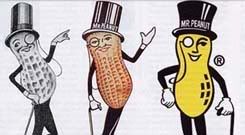
Mascots for brands of foods tend to be very disturbing and doubly so when they're the actual food itself. Does it bother anyone else that some of our most loved mascots are imploring you to eat them?


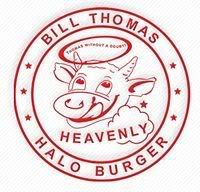
Okay, so Charlie Tuna's not very lovable (Is that his hair? Is he wearing a beret?), but everyone loves the Pillsbury Doughboy, and what man wouldn't want to be the dashing Mr. Peanut? What woman wouldn't want to spend a night embraced in his...arms? So it's easy to miss the gruesome irony behind their smile of lies. With other mascots, it's not, such as the horrifying Halo Burger Cow.


When we were a child, this terrified us. It's not enough that you have to be reminded of how adorable the thing you're eating used to be, no, Halo Burger trips even the most clearly defined boundaries of taste and decency and shows the cow licking its lips! Somehow it's tasted the blood of its own species--perhaps the flesh from its very own hide--and is hungry for more!

Equally disturbing, especially to a schooled and cowardly child like we, was the knowledge that cows are herbivores, and if Halo Burgers were enough to throw 1400 pounds of peace-loving mammal into a goddamn cannibalistic frenzy, just imagine what it'd do to a mincing little tot like we!

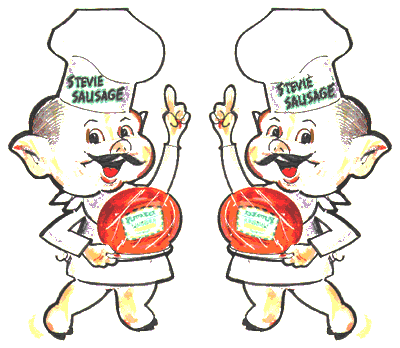
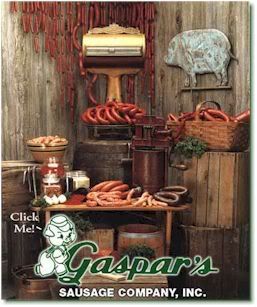
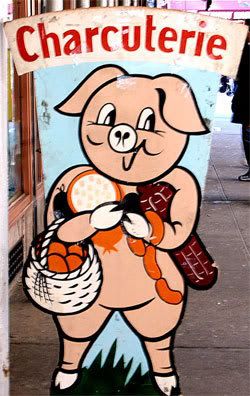
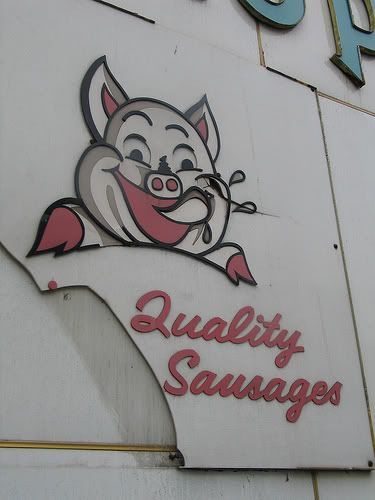
But we decided to face our fears and go in search of other similarly disturbed mascots. What we found was that pigs are chillingly overrepresented in the creepy-mascot crowd:


Somehow we don't feel as off-put about pigs telling you to eat them or their families, since pigs will eat anything, so it's likely they had it coming, but this trend of endorsing cannibalism should make a lot of people uneasy. And we shudder to think why so many have let it slip by unnoticed...

Read More...

proper use of ellipsis

Okay people, hush'n up and read:

Ellipsis points (also known as ellipses, points of ellipsis, and, suspension points) are periods, usually in groups of three, that signal an omission from quoted material or indicate a pause or trailing off of speech.
--Merriam Webster's Manual for Writers & Editors
They are not commas, colons, semicolons, brackets, semibrackets, or guillemets. Do not use them as such.

(We just edited a piece that included 38 ellipses, and only one of them was correctly used, so we're in a bit of a snit.)

Read More...

the difference between which and that

that vs. which: Think of "which" as an aside--a sidenote.

Example:

My trailer, which is also on fire, is a Winnebago

The main idea of the sentence is that the trailer is a Winnebago. That the trailer is on fire has little to no bearing on the company that manufactured it; it's just an interesting little sidenote.

"That" should be used when you need to make a distinction, such as

Of all the trailers, mine is the one that caught fire

If you're not sure whether you're writing a distinction or an aside, try adding "by the way" after each "that" or "which"; if it seems right, then it's probably "which"; if not, it's probably "that."

Or you could just read this sentence by Nietszche

That which we find words for is that which we cannot hold in our heart

until you go insane.

Read More...

starting sentences with and

We don't know about you, but in our public schooling experience, there was a running theme of us being told to forget everything we had learned prior to taking whatever class we were in.

For example, our 7th-grade English teacher told us to forget everything we had learned in our 6th-grade English class; then our 8th grade English teacher told us to forget everything from 7th-grade English; 9th-grade English told us to forget 8th-grade English; and 10th-grade to forget 9th-grade (which was odd because it was the same teacher...)

One of the things we remember constantly forgetting was starting/not starting sentences with conjunctions. For even years (4th, 6th, 8th, 10th, and 12th grade) we were told to not start with conjunctions; odd years (5th, 7th, 9th, 11th) we were told that it didn't really matter. Whether this was borne of opposing syntactical ideologies, professional instructorial apathy, or your common public-school pandaemonic hatred, we can't say or even speculate, as none of our teachers ever gave a reason for their preference--we were to accept it on faith alone, fully knowing that in a year's time we would be branded heretics by the next raving loon, who'd forcibly convert us to his one, true, transient faith.

Synthesizing the presumed wisdom of both sides, we've come to an equally groundless conclusion: You shouldn't do it. But sometimes you should.

When shouldn't you? In our experience, many authors who do begin sentences with conjunctions usually end up writing something like this: "Give him a bone. And some water." Now this drives us up the proverbial F@#$ing Wall. It's not even a sentence! In the "author"'s rush to break the rules of sense and decency over their own backs, he's similarly broken the first rule of writing a sentence: Don't confuse sentences with fragments. Equally cretinous, he's undermined his own credibility by making his thoughts appear impromptu and desultory--the reader is left wondering why those two could not be included in the same sentence.

Now a moment ago we mentioned that many authors begin fragments with conjunctions--that's the worst syn--but almost as bad is something like this: "If you apply a liberal dose of balm, your dog's pads should be fine. But don't overdo it." Grammatically acceptable, but stylistically perverse--the two sentences could easily be combined without disturbing the author's meaning, so why not do so? Worse, separating the two places undue emphasis on the latter sentence: Even if the author only meant it in passing, say as an aside, the reader is likely to misinterpret this and presume that since the "aside" is given its own, distinct sentence, it must be just as important as the sentence preceding.

In fact, it is precisely when you want to add emphasis that you should begin with a conjunction, and we offer our own conclusion, "You shouldn't do it. But sometimes you should" as an example: Both sentences require equal emphasis because we want the reader to give them both equal consideration. We don't doubt that the reader could understand if we fused the two sentences, but breaking them up makes the author's intent more clear.

It's not a crime to have more than one thought per sentence; that's what conjunctions are for, which is why we should use them--our readers are likely to be at least as intelligent as we, and they can follow multiple thoughts contained within a single sentence; we don't need to write everything like we're listing ingredients--so have at it--just (one more thing): Don't try to cram so much into one sentence that you render your reader tizzled--and don't get on our case for doing so, after all, we went to public school.

Read More...

A coworker recently commented on the widespread misplacement of “only.”

This came as quite a revelation to us, not only because we had never considered it in detail, but also because, we soon discovered, we were frequent offenders!

Our coworker pointed out that many people place “only” in front of a verb when it’s only supposed to modify a noun or adjective.

For example:

You say four raccoons are on the deck, but I only see one.

We can guess that the speaker means he sees only one raccoon instead of four, but since he has placed “only” in front of the verb, what he’s literally connoting is that he senses the raccoon through sight alone—he doesn’t hear it, he doesn’t smell or taste it, etc.

In this instance the numbers clear up the ambiguity; it’s not very difficult to understand that the speaker means he sees only one raccoon as opposed to four even when “only” is placed in front of the verb. However, without such is not always the case, and when it's not, horrendously bloody communicative apocalypses tend to ensue.

What’s your problem, Little Mac? You only walked two miles.

This can be especially soul-shattering when one means “only” to correspond with “two miles” instead of “walked.” Thus composed, the speaker’s concern is for the method of conveyance instead of distance—should Mac have run? Drove? Ridden a pale horse?

So keep a keen eye and ear tuned toward your word placement—if you don’t, your speech will get only worse.

Read More...